How Do You Test an AI-Written App Without Writing Tests? What os verify Proves in Two Stages
os verify on the published 18.5.0 runs two stages — author-time rules, then a real in-process boot — and the second never starts if the first refuses. Three transcripts, one failing on purpose, and what a green run did not prove.
Run this before you read on. It takes under two minutes on a clean machine, and the last line is the whole post in one character.
npm create objectstack@latest verify-demo && cd verify-demo
npx os verify --json > report.json; echo $?0The short answer. You cannot test an AI-written app’s business logic without writing tests, and nothing below claims otherwise. What you can do, with one command, is prove two narrower things the runtime is in a position to prove: that the definition is enforceable — the same author-time rules os validate runs — and that the app behaves: it boots, and every object round-trips a record through the real HTTP stack. On ObjectStack 18.5.0, the version npm create objectstack@latest installs today, that command is os verify. It runs those two stages in order, the second stage never starts if the first refuses, and the exit code is read from one count, hardFailures. The rest of this post is three real runs of it — the blank scaffold, the CRM example with its three declared positions, and one run that fails on purpose — plus one run of the five other proofs it offers on request — because the most useful thing a verifier can show you is what it refuses, and the second most useful is what it admits it did not prove.
Two stages, one count
The CLI reference states the contract in one sentence: “The done-bar: os verify green means the author-time rules pass and the app behaves at runtime. It runs two stages, in order, and the second starts only when the first passes.” Two words are worth keeping apart from here on. os validate is the gate: it decides whether a definition is enforceable. os verify is the done-bar: enforceable and behaves.
| Stage | What runs | What a failure looks like |
|---|---|---|
| 1 · Author-time rules | The rule registry os validate runs — 68 rules on 18.5.0 — over the stack prepared the way os validate prepares it | Exit 1 and a JSON document with error and errors[]; the runtime stage did not run |
| 2 · Runtime | Boot the app in-process, judge the seed the boot landed, and, for every object, derive a record from its fields, create it through the real HTTP stack, read it back, compare | seed.hardFailures, createFailed, readFailed and fidelityGaps each add to hardFailures |
On request · --rls | A second fresh boot proves the cross-owner invariant — “a member must not write what it cannot read” — for a probe persona and for one persona per declared position | A hole, a degraded probe persona, or a declared position the run could not provision each add to hardFailures |
| On request · five more proofs | --reference-shapes, --delete-behaviors, --unique-scopes, --parent-write-reach, --dashboard-windows: each boots another fresh stack and proves one declared behaviour, through the REST door and the system door | Each family’s own summary.hardFailures adds to hardFailures; inconclusive and excluded legs are reported, not counted |
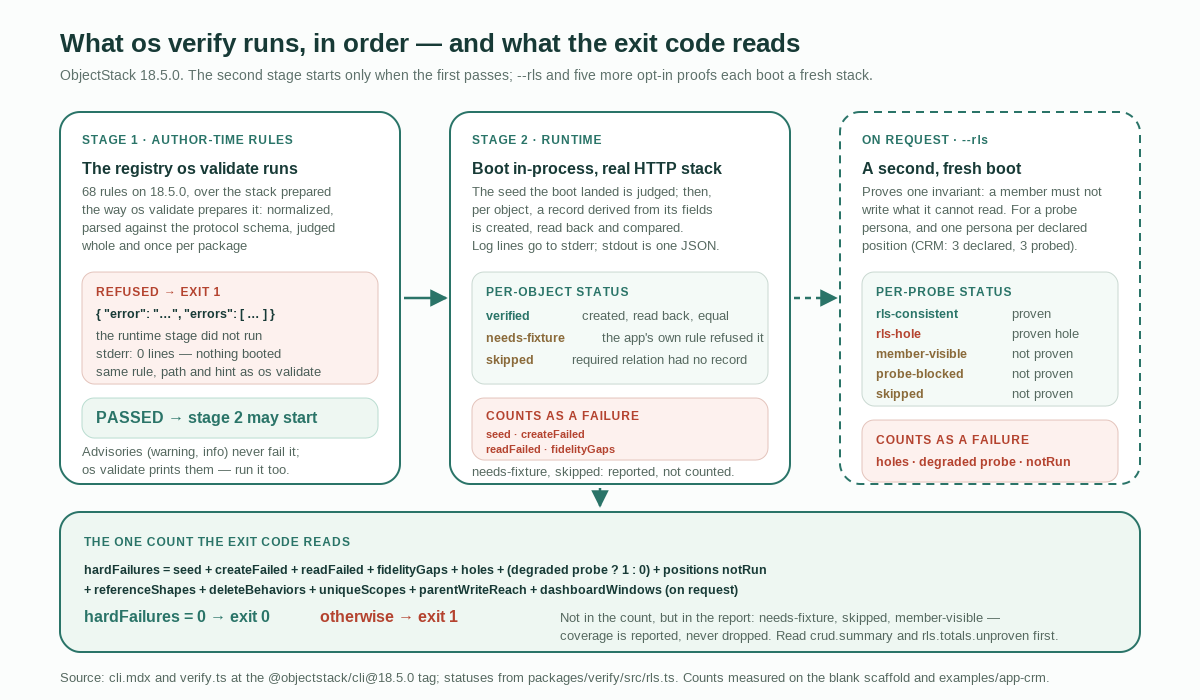
The count the exit code reads is twelve terms — one from the seed, three from the round-trip, three from --rls, one per opt-in family — and the source states them plainer than any paraphrase (packages/cli/src/commands/verify.ts lines 460-492 at the 18.5.0 tag, its comments cut):
const hardFailures =
  seed.hardFailures +
  crud.summary.createFailed +
  crud.summary.readFailed +
  crud.summary.fidelityGaps +
  (rls?.totals.holes ?? 0) +
  (rls?.probe.degraded ? 1 : 0) +
  (rls?.positionCoverage.notRun.length ?? 0) +
  (referenceShapes?.summary.hardFailures ?? 0) +
  (deleteBehaviors?.summary.hardFailures ?? 0) +
  (uniqueScopes?.summary.hardFailures ?? 0) +
  (parentWriteReach?.summary.hardFailures ?? 0) +
  (dashboardWindows?.summary.hardFailures ?? 0);
Hold on to what is not in that list — needsFixture, skipped, memberVisible. They come back in the CRM run, and they are the reason the exit code is the second thing you should read, not the first.
Stage one closes a false green
The ordering is not a detail, and it has a history. Before 17.7.0, os verify booted the app and ran the round-trip, and nothing else. The 17.7.0 changelog records what that admitted, in its own words:
A stack carrying a lookup to an object that does not exist, an action
visibleexpression naming a field withoutrecord., or a list column naming no field booted, round-tripped its records and printed✓ verify passedat exit 0, whileos validate,os buildandos lintall refused it. The documented done-bar (“objectstack verifyis green”) was green on a stack the build refuses to ship.
Call that shape a false green: a verifier that passes what the build refuses. It is the worst defect a verifier can have, because the whole point of running one is to be the thing that notices. Since 17.7.0 the gate runs first, and on 18.5.0 it still does. The fastest way to see the closure is to open the hole on purpose. Take the scaffold’s one object and give it a lookup to an object that does not exist — four lines, the kind of thing an agent writes when it names a target before it creates it:
     body: Field.textarea({
       label: 'Body',
       group: 'details',
     }),
+    project: Field.lookup('verify_demo_project', {
+      label: 'Project',
+      group: 'details',
+    }),
   },
Then run the done-bar again, on 18.5.0:
$ npx os verify; echo $?
  → Running author-time rules (68)...

  ✗ Author-time rules failed (1 issue) — the runtime stage did not run
  • object "verify_demo_note" · field "project": lookup target "verify_demo_project"
    resolves to no object defined in this stack. The reference is inert at runtime —
    nothing reports the miss. Did you mean "verify_demo_note"?
      fix: Point it at one of this stack's objects, or at a platform object by its full
      name (the platform user object is "sys_user", not "user")
      rule: object-reference-unknown  at objects[0].fields.project.reference — `os explain
      object-reference-unknown` for how an object name resolves, and what a miss costs
1
And the machine-readable face of the same refusal:
$ npx os verify --json > report.json; echo $?
1
$ cat report.json
{"error":"Author-time rules failed (1 issue) — the runtime stage did not run",
 "errors":[{"severity":"error","rule":"object-reference-unknown",
   "where":"object \"verify_demo_note\" · field \"project\"",
   "path":"objects[0].fields.project.reference",
   "message":"lookup target \"verify_demo_project\" resolves to no object defined in this stack. …",
   "hint":"Point it at one of this stack's objects, or at a platform object by its full name …"}]}
Three things in that output are the mechanism. The sentence the runtime stage did not run is literal: the run wrote 0 lines to stderr, where a run that boots writes two (next section) — no plugin loaded, no server started, no database touched. The finding is the one os validate prints for the same stack, same rule name, same path, same hint, so an agent that reads either gets the same corrective instruction, with a Did you mean, a fix: line and the os explain command that says why the miss matters. And the exit code is 1 with the document on stdout, which is the shape a CI step and a script can both act on without parsing prose.
Stage two: one record per object, through the real HTTP stack
Restore the field and the done-bar reaches its second stage. This is the scaffold’s full report — one object, two fields:
{
  "app": "com.example.verify-demo",
  "config": "/…/verify-demo/objectstack.config.ts",
  "multiTenant": false,
  "seed": {
    "status": "none", "suppressed": [], "inFlight": 0, "sources": [],
    "totals": { "inserted": 0, "updated": 0, "skipped": 0, "rejected": 0, "droppedRefs": 0 },
    "hardFailures": 0
  },
  "crud": {
    "app": "com.example.verify-demo",
    "results": [
      { "object": "verify_demo_note", "status": "verified", "checked": 2 }
    ],
    "summary": {
      "objects": 1, "verified": 1, "fidelityGaps": 0, "createFailed": 0,
      "needsFixture": 0, "readFailed": 0, "skipped": 0, "mismatchTotal": 0
    }
  },
  "hardFailures": 0
}
checked: 2 is the two fields the verifier wrote and read back; mismatchTotal: 0 says every value came back as written; seed.status: "none" says the scaffold declares no seed records for the boot to land. What is not in the file is as deliberate as what is: the booted stack’s own log — here the dev metadata endpoint registering and the server stopping — went to stderr, two lines of it on this one-object app, and stdout carried exactly one JSON document. That contract dates from 17.7.0 as well; its changelog measured the previous behaviour at 318 log lines landing on stdout ahead of the report on a two-object stack, so that os verify --json > report.json “used to exit 0 and leave a file no JSON parser accepts.” Now JSON.parse reads the file whole, which is what makes report.json an artifact you can attach to a pull request rather than a screenshot.
A record “derived from its fields” is the verifier’s record, not yours, and that has a consequence the scaffold is too small to show. Here is the CRM example — examples/app-crm at the @objectstack/[email protected] tag, six objects, run against the published 18.5.0 packages — on the text face, where the verifier cuts the quoted refusal at the code:
=== objectstack verify — com.example.crm ===
  ✓ crm_account  (4 fields)
  ✓ crm_activity  (7 fields)
  ✓ crm_contact  (3 fields)
  ✓ crm_lead  (9 fields)
  ~ crm_opportunity  needs-fixture (app validation rejected the auto-record):
    {"error":"Discount cannot exceed 40% without an approved exception.; Close Date must be
    today or a future date.","code":
  – crm_opportunity_line_item  skipped: required relation "opportunity" → no created
    "crm_opportunity" record
  ── 4 verified, 0 gaps, 0 FAILED, 1 needs-fixture, 1 skipped (0 mismatches)
  ✓ seed: 28 records landed (28 inserted, 0 updated, 0 already present)
Four of six objects round-tripped. The fifth, crm_opportunity, carries two validation rules of its own — a discount ceiling and a close-date floor — and the record the verifier derived satisfied neither, so the app refused it with a 400. That is reported as needs-fixture, with the app’s own refusal quoted, and it is not a failure: the verifier is telling you it could not construct a record that passes your rule, not that the object is broken. The sixth is skipped, because a line item requires an opportunity and none was created. Neither term is in the hardFailures sum, so this run exits 0 — honestly, since nothing it exercised was wrong, and legibly, since the two objects it did not exercise are named with the reason. The line under the summary is the seed: the boot landed all 28 records the CRM declares, and one it dropped would have been a term in hardFailures. Read the summary line before the exit code.
On request: the cross-owner invariant, one persona per declared position
The round-trip proves fidelity. It proves nothing about who can write what, and os verify does not pretend to by default. With --rls it boots a second, fresh stack and proves one invariant — the reference’s phrasing is “a member must not write what it cannot read” — for a probe persona it provisions itself and, on 18.5.0, for one persona per position the app declares. Since 18.0 the probe persona’s permission set is registered in the app’s security catalog for the run rather than written as a row, and a boot that cannot serve it reports a degraded probe persona — a term in hardFailures — instead of probing with something weaker. The CRM declares three, in src/security/sales-positions.ts: crm_sales_rep, crm_sales_manager and crm_finance_approver. So npx os verify --rls --json minted four personas, and the report’s rls block says what each one established:
"rls": {
  "app": "com.example.crm",
  "probe": { "label": "[email protected]", "grantedObjects": 6 },
  "results": [
    { "object": "crm_account", "status": "rls-consistent", "target": "created",
      "detail": "the probe cannot read (GET 404) and could not mutate (PATCH 404, row unchanged)" },
    …
  ],
  "unproven": [ … ],
  "summary": { "objects": 6, "consistent": 6, "holes": 0, "memberVisible": 0,
               "probeBlocked": 0, "skipped": 0, "proven": 6, "unproven": 0 },
  "positionRuns": [ … ],
  "positionCoverage": {
    "declared": ["crm_sales_rep", "crm_sales_manager", "crm_finance_approver"],
    "ran":      ["crm_sales_rep", "crm_sales_manager", "crm_finance_approver"],
    "notRun":   []
  },
  "totals":  { "objects": 24, "consistent": 6, "holes": 0, "memberVisible": 18,
               "probeBlocked": 0, "skipped": 0, "proven": 6, "unproven": 18 }
},
"hardFailures": 0
The base probe persona proved the invariant on all six objects: it could not read another owner’s row (GET 404) and, when it tried to write that row by id anyway, the write was refused and the row was unchanged (PATCH 404). That is the by-id-write class of hole — the one where a record you cannot see can still be edited if you guess its id — and on this app it is closed.
Then read the position personas, where the text face is blunter than the JSON:
  ── position personas (each holds one declared position and nothing else) — 3 of 3 declared position(s) probed
  ▸ crm_sales_rep  ([email protected])  0 PROVEN (0 consistent, 0 HOLES) · 6 NOT PROVEN (6 member-visible, 0 probe-blocked, 0 skipped)
      ⚠ this persona proved NOTHING — every object was member-visible, probe-blocked or skipped.
  ▸ crm_sales_manager  …  0 PROVEN · 6 NOT PROVEN (6 member-visible, …)
      ⚠ this persona proved NOTHING — every object was member-visible, probe-blocked or skipped.
  ▸ crm_finance_approver  …  0 PROVEN · 6 NOT PROVEN (6 member-visible, …)
      ⚠ this persona proved NOTHING — every object was member-visible, probe-blocked or skipped.
  ══ all personas: 6 PROVEN (6 consistent, 0 HOLES) · 18 NOT PROVEN (18 member-visible, 0 probe-blocked, 0 skipped)   [unit: one object × persona probe]
✓ verify passed — no runtime failures
18 of 24 probes proved nothing, and the run is green. Both halves of that sentence are correct, and the report is built so that you can see both. Each of the CRM’s three positions distributes the same permission set, crm_sales_user, in its permissionSets, and that set grants read on every CRM object; five of the six objects declare sharingModel: 'public_read_write', and the sixth follows its parent. A persona that can read every row is never in a cross-owner situation, so there is no hole to find, and the verifier reports exactly that — member-visible, not proven — rather than counting a probe it could not run as a pass. The five statuses are a closed list:
| Status | Verdict | Meaning |
|---|---|---|
rls-consistent | proven | The persona could not read the row and could not mutate it |
rls-hole | proven hole | The persona could not read the row yet mutated it by id — counts in hardFailures |
member-visible | not proven | The persona can read the row, so there is no cross-owner scenario to test |
probe-blocked | not proven | The object gate refused the persona, so record scope was never consulted |
skipped | not proven | No probe target could be established |
One rule governs the whole block, and it is the second idea worth taking from this post: coverage is reported, never dropped. A declared position the run could not provision does not shrink the run quietly — it lands in positionCoverage.notRun, and that list’s length is a term in hardFailures, so a verifier that covered less than its numbers read fails instead of passing. A persona that ran but proved nothing is kept too, as unproven, with the reason per object. The exit code tells you nothing was found wrong; totals.unproven tells you how much of the question was actually asked. On this app the answer is a quarter of it, and you now know which quarter.
Five more proofs on request, under the same rule
Since 18.0 os verify offers five more proof families, each opt-in and each on a fresh boot of its own: --reference-shapes (a reference field refuses a value that is not a record id), --delete-behaviors (each declared deleteBehavior is what a delete of the referenced record does), --unique-scopes (each unique field collides where its scope says), --parent-write-reach (a controlled_by_parent detail write is admitted exactly when the caller can edit its master) and --dashboard-windows (a dashboard’s date picker counts the rows its window selects). Each family adds its own summary.hardFailures to the count; what it could not settle is reported, not counted. All five at once on the CRM:
$ npx os verify --reference-shapes --delete-behaviors --unique-scopes \
    --parent-write-reach --dashboard-windows --json > families.json; echo $?
0"referenceShapes": { …, "summary": { "fields": 10, "proven": 7, "holes": 0, "failed": 0,
"inconclusive": 3, …, "hardFailures": 0 } },
"deleteBehaviors": { …, "summary": { "fields": 10, …, "proven": 8, "contradicted": 0, "failed": 0,
"inconclusive": 0, "excluded": 2, …, "hardFailures": 0 } },
"uniqueScopes": { …, "summary": { "fields": 0, …, "proven": 0, …, "hardFailures": 0 } },
"parentWriteReach": { …, "summary": { "objects": 1, "probed": 1, "proven": 1, "contradicted": 0,
…, "held": 60, …, "hardFailures": 0 } },
"dashboardWindows": { …, "summary": { "dashboards": { "declared": 1, "windowed": 0, "notWindowed": 1, … },
…, "hardFailures": 0 } },
"hardFailures": 0The rule from the personas holds here too. Two families proved nothing on this app — it declares no unique field, and its one dashboard declares no date range — and the cross-organization leg of --unique-scopes is reported not run, because the boot was single-organization. The three inconclusive reference fields trace back to the same discount and close-date rules that made crm_opportunity a needs-fixture. Exit 0, and every one of those gaps is named in the file.
What a green os verify does not say
Six limits, stated plainly, because a verifier that oversells is the false green in a different coat.
- Nothing about correctness. The 40% discount ceiling is enforced; whether 40 is the right number, whether finance should approve, whether the object should exist —
os verifyhas no opinion and no mechanism. That is the third rung of declared → enforceable → correct, and it is still a reviewer’s job. If your business logic has rules worth keeping, write tests for them; the done-bar is the floor under those tests, not a replacement. - Not all of
os validate. The reference is explicit: stage one is the rule registry, and “thedefineStackprovenance refusal …, the package-docs lint, the capability-provider check, the picklist-reference and view-container-name checks and--strictstayos validate’s, so run it too.” Advisories —warningandinfofindings — never failos verifyeither; the CRM run counted 4 of them and pointed atos validateto read them. needs-fixtureandskippedare not failures. Two of the CRM’s six objects were never round-tripped and the run exited 0. The summary line says so; the exit code cannot.--rlsproves one invariant, one class, where a scenario exists. It says nothing about whether the permission set is the right one — that is pass 2 of the review: check the values, not the keys — and on an app whose personas can read everything it proves nothing about them, and says so.- It is opt-in and single-tenant by default. Without
--rlsno persona is minted, and without its own flag none of the other five families runs. Without--multi-tenantthe boot is single-organization, so tenant-isolation policies are not what was exercised — unless the environment sets a walled tenancy posture (OS_TENANCY_POSTUREset toisolatedorgroup), which asks for the same org-scoped boot. - It is not the human verify. The getting-started loop’s step 4 is “You verify in the Console UI” — a person, looking at the running app. Same word, different act.
os verifyis the mechanical half; it does not look at a screen.
Where it sits in the loop
The loop this site keeps describing has an input side and an output side. On the input side you point your agent at ObjectStack — the rules file, the skills bundle, the tool server — and it writes typed metadata. On the output side, the metadata goes through the gate (os validate: enforceable, or refused with a message the agent can act on), then the done-bar (os verify: boots and behaves, with a report of what was and was not proved), then review for the one rung no gate climbs, then a person in the Console. The CRM build on this site ran the gate, the build and the dev server, and never the done-bar; this is the step between that and sign-off, and it is one line in CI:
npx os validate && npx os verify --rls --json > verify-report.json
node -e "const r=require('./verify-report.json'); console.log('hardFailures', r.hardFailures, '· rls unproven', r.rls?.totals.unproven ?? 'n/a')"
Attach verify-report.json to the pull request. A reviewer then reads three lines before the diff: the exit code, the crud.summary, and rls.totals.unproven — and knows, before forming an opinion, what has been established mechanically and what remains a question of judgement. That division is the entire argument for a declared, enforced target format when the author is a model: the machine takes the rungs it can take and reports the ones it cannot.
Point your agent at that target and let it run the done-bar itself. The README’s description of the command is the whole promise, and no more: os verify # Boot the app in-process and verify it over real HTTP. To run it, the ObjectStack repository ships ObjectOS Community — the ghcr.io/objectstack-ai/objectstack image, os start and the Console, free and self-hosted — while ObjectOS Cloud is the hosted edition and ObjectOS Enterprise the self-managed, licensed one.
Verified against ObjectStack 18.5.0 — create-objectstack 18.5.0 and @objectstack/cli 18.5.0 as npm create objectstack@latest installed them on 2026-11-16, on Node 22. The CRM is examples/app-crm at the @objectstack/[email protected] tag, run against the published 18.5.0 packages; source citations are at the same tag. Every command and every block of output above was run, not reconstructed; output is trimmed where marked with an ellipsis and nowhere rewritten.